- His hand-drawn diagrams were comparable in detail to those from an EM.
- His work was indeed exceptional, and they would publish it.
- They would also offer him a grant to procure an EM.
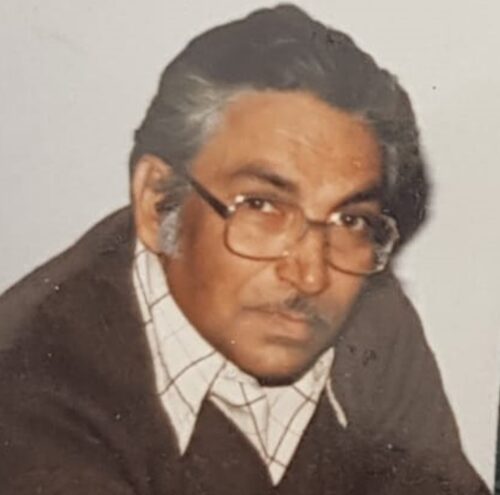
His colleague and friend, Dr. Nishith Kumar, once remarked, “With his multifaceted and immense talent, he deserved much more than he ever received.” Indeed, my father was a man of many talents.
One of his friends, Om Shanker Uncle, remembered him saying, “My dear Arun was a gifted cricketer. We will miss you, yaar.” He was a stylish wicket keeper and opening batsman who played for Lucknow University’s team and was selected by C.K. Naidu for further training. His cricket kit, a cherished possession, he eventually gifted to a student aspiring to lead the Gorakhpur team.
But his passion extended beyond sports. As Asar Sahab, a well-known poet, expressed, “It is my personal loss. Narayan Sahab was a fine poet and a great lover of poetry. He will forever remain in my heart.” As a young boy, my father ran errands for Firak Gorakhpuri, helped in the funeral of the famous Majaz, while writing ghazals under the pen name Narain Lakhnavi. He established poetry forums like “Diarae Koshish” and “Kavilok” and continued writing until his last days. I vividly remember him, seated in his wheelchair, sharing his thoughts on Sahir Ludhianvi. “Beta, I’m struggling with the rhythm,” he would tell me, even just days before he left us.
A true craftsman, my father’s handwriting was impeccable, whether in Urdu, English, or Hindi—it looked as though typed. And just as he shared “pearls of wisdom,” he left us pearls of thought, values, simplicity, and integrity. Though we have lost them , yet the delicate models of beautiful homes that he would craft with small bottles and other scrap material are fresh in my memory.
He was old school, with artistic, skillful hands. He created beautiful models, village sketches, oil paintings, handmade greeting cards, and even crafted furniture like stools and trolleys. His hands and mind were never idle. His extraordinary intellect was matched only by his deep curiosity, as he explored fields ranging from science and politics to spirituality.
His students—Jayant Misra, Kanwaljeet, and others—fondly remembered his lectures as unmissable. With clear, insightful explanations, intricate diagrams, dry humor, and a resonant voice, he kept them captivated. He had a rich, deep voice that suited Mukesh, Manna Dey, and Hemant Kumar’s songs, which he sang with finesse.
Known for his intelligence, quick wit, and silken voice, he was a sought-after emcee and quizmaster. His empathy, perhaps his greatest strength, guided him through social work, from helping flood victims to organizing eye camps and chairing the Lions Club in Gorakhpur. He was even the Zonal Chairman of the club.
My father loved to read and explore knowledge, and he never limited himself to one field. His work on the Buddha Trail with Lahiri Uncle in Gorakhpur, resulting in the book “Saryupar,” remains a testament to his versatility. All the maps in that book—precisely drawn by him—reflect his dedication to accuracy.
He was a perfectionist, continuously observing, learning, and honing his craft. And yet, he was an unsung genius, for he never sought the limelight. As a friend D.C. Srivastava said, “He was far greater than what Gorakhpur had to offer; he belonged in bigger universities.” My father, however, was content and unambitious, delighted that letters addressed simply with his name still reached him, even without an address.
In all his roles, my father was a man of principle and discipline. He was the kind of person who, despite being President of the University Athletics Association, stood firm against any form of hooliganism. Many incidents he shared, shaped the way I handle challenges today.
Above all, he was a father of pure, unconditional love. My father did everything for me, from helping me write my first poem at eight to making my charts and models, teaching, guiding, and accompanying me to every event. He celebrated every small achievement of mine, serving as my friend, philosopher, and guide.
In his final days, he spoke of a temple he saw, with doors closed, guarded by Lord Ram and Lakshman. He believed they wouldn’t let him in, thinking he might run away. Yet, as he took his last sip of Ganga jal from my trembling hands, I feel those doors must have opened.
I pray to that Almighty who took him from us to grant him peace and a place in heaven, for he was a man who gave unconditionally. And if there is a next life, may we meet again as father and child.
We love you forever, Papa.BTG (bye.bye, tata, good luck)